Introduction: STMicroelectronics (ST) has introduced a new family of high-resolution Time-of-Flight (ToF) sensors, bringing advanced 3D depth-imaging capabilities to devices such as smartphones.
STMicroelectronics (ST) has introduced a new series of high-resolution Time-of-Flight (ToF) sensors, bringing advanced 3D depth-imaging capabilities to devices such as smartphones.
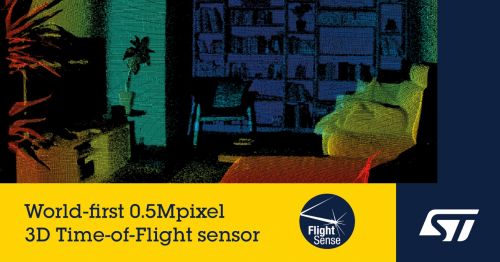
The first product in the new 3D series is the VD55H1. This sensor performs 3D imaging by sensing the distance of more than 500,000 points. Objects within a 5-meter range of the distance sensor can be detected, and even more distant objects can be detected through the patterned illumination system. The VD55H1 can address use case issues in emerging AR/VR markets, including room mapping, gaming, and 3D avatars. In smartphones, the new sensor can enhance camera system features, including bokeh effects, multi-camera selection, and video segmentation. Higher resolution and more accurate 3D images can also improve the security of facial authentication, better protecting phone unlocking, mobile payments, and any smart systems involving secure transactions and access control. In robotics, the VD55H1 provides high-fidelity 3D scene maps for all target distances to enable new and more powerful features.
Eric Aussedat, Executive Vice President and General Manager of the Imaging Sub-Group at STMicroelectronics, stated: “The innovative VD55H1 3D depth sensor strengthens ST's influence in the Time-of-Flight technology market and completes our depth-sensing technology portfolio. Now, the FlightSense product portfolio includes direct and indirect ToF products ranging from single-point ranging all-in-one sensors to complex high-resolution 3D imagers, enabling the next generation of intuitive, smart, and autonomous devices.”
Indirect Time-of-Flight (iToF) sensors, such as the VD55H1, calculate the distance between the sensor and an object by measuring the phase shift between the reflected and emitted signals, whereas direct Time-of-Flight (dToF) sensor technology measures the time it takes for a signal to be emitted and reflect back to the sensor. STMicroelectronics' broad portfolio of advanced technologies enables it to design both direct and indirect high-resolution ToF sensors, providing customized and optimized solutions for specific application requirements.
The unique pixel architecture and manufacturing process of the VD55H1, combined with STMicroelectronics' 40nm stacked-wafer technology, ensure low power consumption, low noise, and an optimized die area. Compared to existing VGA sensors, this chip increases the number of pixels by 75% while featuring a smaller chip area.
The VD55H1 sensor is now delivering sample batches to key customers for testing. Mass production is scheduled for the second half of 2022. To help customers accelerate sensor functional evaluation and project development, STMicroelectronics also provides reference designs and a complete software package.
Technical details
The iToF depth-sensing sensor VD55H1 features a 672 x 804 backside-illuminated (BSI) pixel array, making it the industry's first product of its kind.
The unique feature of the new sensor is its ability to operate at a 200MHz modulation frequency, with a 940nm wavelength demodulation contrast exceeding 85%, and a depth noise that is half of existing sensors typically operating around 100MHz. In addition, multi-frequency operation, advanced depth unwrapping algorithms, low pixel read noise, and high pixel dynamic range ensure excellent long-range ranging accuracy for the sensor. Depth accuracy is better than 1%, with a typical accuracy of 0.1% of the distance.
Other features include short capture sequences that support frame rates up to 120 fps and improve motion blur robustness. In addition, advanced clock and phase management features, including a spread spectrum clock generator (SSCG), provide multi-device interference suppression and optimized electromagnetic compatibility.
In some streaming modes, power consumption can be reduced to below 100mW, helping to extend the battery life of battery-powered devices.
STMicroelectronics has also developed a consumer device appearance reference design for the VD55H1, featuring an illumination system on the board, along with a companion full-featured software driver and a software library that includes an advanced depth map reconstruction image signal processing pipeline compatible with Android embedded platforms.